
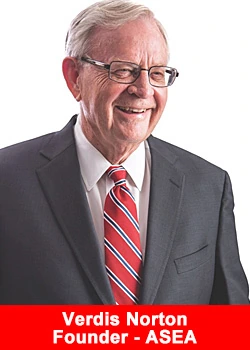
Based on available public records and business reporting as of June 2026, Verdis Norton's estimated net worth falls in the range of $10 million to $30 million, with the most defensible midpoint estimate sitting around $15 to $20 million. That range reflects his role as a co-founder of ASEA, a privately held nutritional supplement company, combined with his prior corporate career at Kraft Foods. Because ASEA is not publicly traded and Norton is described as a retired founder, hard financials are not publicly disclosed, which means this estimate carries meaningful uncertainty and should be treated as a reasoned approximation rather than a confirmed figure.
Verdis Norton Net Worth: Estimate, Sources, and Reliability

Marcus Rothwell
13 Jun 2026
Who Verdis Norton actually is (and clearing up any identity confusion)

This is worth addressing directly because 'Verdis Norton' is an uncommon name, but it does appear in a few different contexts that could cause confusion.
The most publicly documented individual with this name is associated with the following verified data points: Sandy, Utah as a listed address on USPTO patent filings; co-founder and former CEO status at ASEA (a cellular health and redox supplement MLM company); prior executive experience at Kraft General Foods and Kraft Foods, specifically as Vice President of Strategy; president of aLF Ventures LLC; and a 2006 board appointment at Medical Discoveries, Inc. A publicly indexed bio hosted by Npros.
com at the Verdis Norton profile likewise identifies Verdis Norton as the founder/CEO/co-founder of ASEA, a cellular health and redox supplement company co-founder and former CEO status at ASEA. , documented by BioSpace and echoed by BioCentury.
BioCentury’s Medical Discoveries board appointment update also echoes the same Oct. 2006 board news with the same core identifying details, including his appointment and prior roles at aLF Ventures and Kraft-related experience.
Patent filings at the USPTO also list a Verdis Norton of Sandy, UT as inventor and assignee through Reoxcyn Discoveries Group LLC, the entity that underpins ASEA's core product patents.
Cross-referencing those data points, the identity picture is fairly coherent: one person, based in the Salt Lake City area of Utah, with a corporate strategy background who transitioned into biotech/supplement entrepreneurship in the mid-2000s. The ASEA company history and a PDF titled 'blank" rel="noopener noreferrer">THE ASEA STORY' both explicitly name Verdis Norton as founder. There is no strong evidence of a separate, equally prominent public figure sharing this name who would produce conflicting results. If you are researching a different Verdis Norton, say a private individual in an unrelated field, none of the financial estimates here apply to them.
The career arc that built his wealth
Understanding where Norton's money likely came from requires walking through his career in rough chronological order, because his wealth profile looks very different at each stage.
Corporate years at Kraft

Norton spent a significant portion of his career at Kraft General Foods and later Kraft Foods, where he held a Vice President of Strategy role. VP-level executives at major consumer packaged goods companies in that era typically earned base salaries in the $200,000 to $500,000 range, supplemented by annual bonuses and in some cases deferred compensation or stock options tied to Kraft's parent companies (Philip Morris/Altria at various points). This phase of his career, while not making him independently wealthy by itself, would have provided substantial savings capital and the strategic credibility that later helped him raise backing for a new venture.
aLF Ventures and the biotech pivot
After leaving Kraft, Norton operated as president of aLF Ventures LLC, which appears to have functioned as a holding or consulting entity. By October 2006, he was appointed to the board of Medical Discoveries, Inc., a biotech firm, suggesting he was actively investing time and possibly capital in the life sciences space. This period represents his transition from corporate executive to entrepreneur-investor, a move that carries income uncertainty but sets up potential upside if ventures succeed.
ASEA and the Reoxcyn patents
The most financially significant chapter is the founding of ASEA. Patent filings under the Reoxcyn Discoveries Group name, with Norton listed as inventor and Sandy, UT as the location, show that he was involved at the intellectual property level, not just as a figurehead. ASEA launched its flagship redox supplement product and built a multi-level marketing distribution network that, by most industry estimates, grew into a company generating tens of millions of dollars in annual revenue.
Founders in MLM companies who hold equity and royalty-like arrangements from early-stage IP can accumulate significant wealth if the company scales, and ASEA did scale meaningfully across North America and internationally. Norton has since been described as a retired founder, which typically implies he transitioned out of day-to-day leadership while potentially retaining an equity stake.
How the net worth estimate is calculated

Net worth is simply assets minus liabilities. For a private individual like Norton, where no public financial disclosures exist, the estimation process relies on triangulating signals from multiple partial sources rather than reading a balance sheet directly. For a related perspective on Vinatieri net worth, compare how private-company valuation signals and equity events are used to build an estimate. Here is how that works in practice for this profile.
- Career earnings: Estimated cumulative compensation from Kraft (VP-level salary over likely 10 to 20 years) minus cost of living suggests he entered entrepreneurship with meaningful capital reserves, potentially $1 million to $3 million in savings and investments.
- Equity in ASEA: As a co-founder with IP ownership (evidenced by patent filings), Norton likely held meaningful equity. ASEA's revenue has been estimated in industry analyses at $100 million or more annually at peak periods. Even a modest founder equity stake of 5 to 15 percent in a company at that revenue level, if the company were ever valued or partially liquidated, could represent $5 million to $20 million or more in paper or realized value.
- IP and royalty income: Patent assignments to Reoxcyn Discoveries suggest Norton or his entities could receive royalty-like arrangements tied to core product formulations, though no public disclosure confirms the amounts.
- Real estate and assets: Sandy, Utah property records are a searchable public record that could add or refine this estimate. No specific property values are included here because current-date deed data was not available in the research corpus.
- Liabilities: No public court judgments, liens, or bankruptcy filings were surfaced in available research for this individual, which is a mild positive signal but not confirmation of a clean balance sheet.
Where to look for better data
If you want to go deeper than this estimate, the following source categories are where actionable evidence lives for a profile like Norton's.
- USPTO Patent Database: Search 'Verdis Norton' or 'Reoxcyn Discoveries' at patents.google.com or the USPTO full-text search. This surfaces assignee relationships and can hint at IP licensing or sale activity.
- Utah County and Salt Lake County property records: Both are searchable online. Look for property purchases, assessed values, and ownership entities that might tie back to Norton or known LLCs associated with him.
- Utah Secretary of State business entity search: Search for Reoxcyn Discoveries Group, aLF Ventures, and any other entities where Norton appears as a registered agent or member. This shows active vs. dissolved status and can hint at business activity.
- SEC EDGAR: Medical Discoveries, Inc. filings from 2006 onward may include board member disclosures or compensation notes tied to the period of his appointment. Search 'Medical Discoveries' on EDGAR for any 8-K or proxy filings.
- BioSpace, PRNewswire, and BioCentury archives: The 2006 press releases about his board appointment are already indexed. Search for subsequent mentions that might track business activity.
- ASEA corporate media and distributor materials: The ASEA Story PDF and official company biography pages are primary sources for career narrative. Check whether any updated biographies include new roles, exits, or equity events.
- LinkedIn and professional directories: Norton has had a public professional presence. A current LinkedIn profile (if active) could show current affiliations or advisory roles that signal income streams.
- Court records via PACER or state-level search tools: Useful for surfacing any disputes, settlements, or judgment liens that could affect net worth estimates.
Putting the estimate in context
| Wealth Component | Estimated Contribution | Confidence Level |
|---|---|---|
| Kraft career savings and compensation | $1M – $3M | Moderate (salary ranges are publicly known; tenure is estimated) |
| ASEA founder equity (potential value) | $8M – $20M | Low-to-moderate (private company; no disclosed valuation or exit) |
| IP / patent royalty income | $1M – $5M | Low (no public disclosure of royalty arrangements) |
| Real estate and other assets | $500K – $2M | Low (no current property records reviewed) |
| Liabilities offset | Unknown, assumed modest | Very low (no public negative signals found) |
| Overall estimated net worth | $10M – $30M | Low-to-moderate overall |
How reliable is this estimate, really
Honestly, the reliability here is in the 'educated guess' range, not the 'confirmed figure' range. This is why estimates for Asa Vermette net worth should be treated as approximations rather than confirmed figures. The core problem is that ASEA is private and Norton is described as retired, meaning there is no ongoing financial disclosure obligation.
The patent record and corporate history give us enough to confirm identity and understand the wealth drivers, but they do not tell us what Norton personally earned, whether he sold equity, whether he has outstanding debt, or what his current lifestyle cost structure looks like. The $10M to $30M range is wide by design: that width reflects genuine uncertainty rather than false precision.
Profiles of similar figures, corporate executives who become founders of moderately successful supplement or health companies, often cluster in this range, which provides some benchmarking validity. But this is not the same as a confirmed net worth.
For comparison, other executives-turned-founders in adjacent sports and health industries show similarly wide estimate ranges at this level of public coverage. Profiles like those for Fernando Verdasco or Marco Verratti, both of whom have more publicly disclosed contract data, allow for tighter estimate windows. Because most footballers like Marco Verratti have earnings tracked through public contracts, their net worth estimates can be easier to corroborate than privately held supplement founders like Verdis Norton. When income is tied to a private company with no public filings, the uncertainty band is simply larger and any site that claims a precise single number without citing a specific valuation event should be treated with skepticism.
How to verify or update this estimate yourself
If you want to do your own research and potentially narrow the range, here is a practical sequence of steps you can take today.
- Start with the Utah Secretary of State entity search (corporations.utah.gov) and look up Reoxcyn Discoveries Group and aLF Ventures LLC. Note whether they are active or dissolved and who the registered agents are.
- Pull the two USPTO patents already identified (US20090110749A1 and US8455010B1) on Google Patents. Check the assignment history tab, which can show if IP was sold or transferred, which would be a major wealth event.
- Search Salt Lake County property records (slco.org) for the name Verdis Norton and any associated LLCs to get a baseline on real estate assets in Sandy, UT.
- Search SEC EDGAR for Medical Discoveries, Inc. filings from 2006 to 2010 to see if any board compensation or equity grants to Norton were disclosed.
- Run a Google News search for 'Verdis Norton' filtered to results from 2020 onward to check for any new business announcements, interviews, or coverage that postdates the core research above.
- If you have access to a court records aggregator like PACER (federal) or your state's equivalent, run a name search to check for any litigation involving Norton personally or his known entities.
- Cross-reference any findings against the ASEA corporate website and official distributor materials, which sometimes publish updated founder biographies with new context about current roles or advisory positions.
The goal of that sequence is to surface any wealth events, equity sales, asset transfers, or new income streams that were not visible in the baseline research. If ASEA was acquired, received outside investment, or if Norton sold his stake, that event would dramatically change the estimate and should be findable in business press or patent assignment records. Until that kind of event is documented publicly, the $10M to $30M range remains the most honest answer available.
FAQ
Why do net worth sites disagree on verdis norton net worth numbers so much?
With a private company, most sites are not seeing a balance sheet. They instead infer wealth from indirect signals like founder equity, revenue at the company level, and early IP ownership, so small assumptions (equity percentage, whether stock or equity was diluted, whether he sold any stake) can swing the estimate widely.
How can I narrow verdis norton net worth below the broad $10M to $30M range?
Look for specific wealth events, not general company success. The most decisive items are documented equity transfers or sales (assignment records, investment announcements that mention founder ownership), and any public filing indicating ownership percentages that later changed.
Does being a co-founder of ASEA automatically mean verdis norton is still wealthy from the company today?
Not necessarily. “Retired founder” can mean he stepped back from operations but still holds equity, or it can mean he reduced or exited his stake. Without a documented equity sale or ongoing ownership disclosure, any current “still benefits” assumption adds uncertainty.
Could verdis norton be confused with a different person, and would that affect the net worth estimate?
Yes, it can. The article highlights identity coherence using address and corporate or patent-linked identifiers. If your research uses only a name without matching those anchors (same location, same entities, same patent/inventor or board records), you can easily attach the wrong financial profile to the wrong person.
What role do patent filings play in estimating verdis norton net worth?
They are strong for confirming identity and involvement in the core IP, but they do not directly reveal personal income. Patents can support an “equity and royalty-like” pathway, yet they still do not tell you whether he retained rights, licensed them, or monetized them via a sale or payout.
If ASEA made tens of millions in annual revenue, why might verdis norton net worth still be much lower or higher than that headline figure?
Revenue is not the same as profit, and profit is not the same as what an individual keeps. The company may have expenses, distributor-related costs, debt, or multiple equity holders, and a founder’s stake can be diluted. On the upside, profitable scaling and equity appreciation can push founder wealth higher, but only if ownership was large and retained.
What evidence would most strongly suggest verdis norton sold equity (which would change the net worth range)?
Published business reporting indicating founder exits, ownership changes, or major transaction events. In addition, patent assignment records or entity-ownership documentation that shows a transfer away from the original IP holder structure can be a hint, especially if tied to a transaction date.
How should I interpret a “precise” single-number net worth claim for verdis norton?
Treat it cautiously. For private founders, any site that gives a single number without tying it to a specific valuation event (equity sale, acquisition, financing round with ownership disclosure) is effectively choosing assumptions rather than reporting confirmed data.
If I want to compare verdis norton net worth with another profile, what’s the best comparison method?
Compare like-for-like on disclosure type. If the other person’s income is tied to publicly documented contracts or public filings, their estimate band can be tighter. For private-company founders, comparison should focus on whether there is documented founder equity, an acquisition, or disclosed liquidity events.
What are common research mistakes when estimating verdis norton net worth?
Overrelying on revenue headlines, assuming founder ownership remained constant over time, and failing to verify the identity using consistent anchors (same individual across entities, same address-linked filings, same IP or board references). Another frequent mistake is mixing up “company value” with “personal net worth” without accounting for liabilities and co-founders.