
The most honest answer to this question is a range, not a number. The Vatican's net worth, depending on which entity you're measuring and what assets you include, sits somewhere between roughly $10 billion and $30 billion in commonly cited estimates. But those figures are built on wildly different assumptions, and most published numbers online don't explain their methodology at all. Here's what the actual financial data shows, where the real uncertainty lives, and how to read any Vatican net worth figure you encounter.
Net Worth of the Vatican: Method, Ranges, and Uncertainty

Marcus Rothwell
13 May 2026

What 'net worth' even means for an institution like this
Net worth in any accounting context means total assets minus total liabilities. For a person or a company, that's relatively straightforward. For the Vatican, it gets complicated fast. You're dealing with an institution that is simultaneously a sovereign state, a religious organization, a diplomatic actor, a real estate manager, a hospital operator, a bank regulator, and a cultural custodian of some of the most irreplaceable art in human history. Not all of those functions have assets that can be meaningfully priced or sold. Some assets are legally restricted to specific purposes. Some liabilities are long-term pension obligations that don't show up neatly on a single balance sheet. Any honest estimate requires spelling out exactly what's included and what isn't.
Vatican City, the Holy See, the Vatican bank: you need to know which one you're asking about
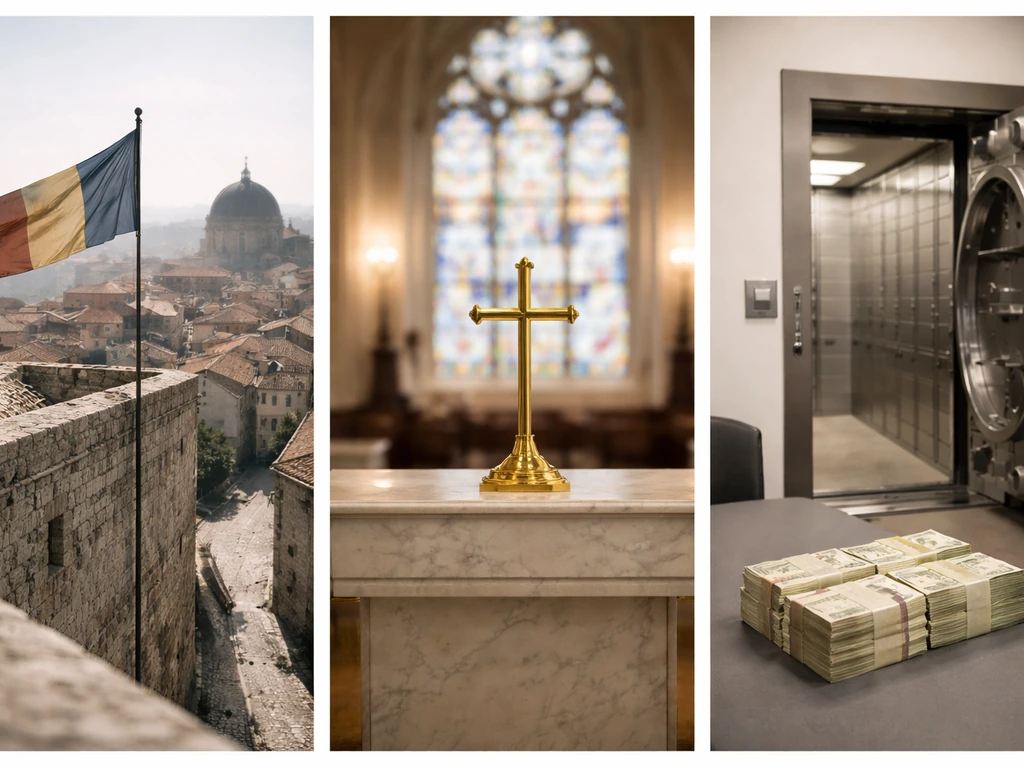
This is the question most net-worth articles skip entirely, and it explains most of the variation in published estimates. There are at least three distinct legal and operational entities commonly bundled under the word 'Vatican.'
Vatican City State
Vatican City State is the physical sovereign territory created by the Lateran Treaty of February 11, 1929. It covers 44 hectares inside Rome, and under that treaty it was granted full property rights and exclusive sovereignty. Vatican City has its own government, its own economy directorate, its own budget, and its own accounting. It is one of the smallest internationally recognized states in the world, but it is a real state with the financial records to match.
The Holy See

The Holy See is the governing institution of the Catholic Church worldwide. It has its own legal personality in international law, meaning it signs treaties, exchanges ambassadors, and operates as a sovereign subject independently of Vatican City State. The Holy See has a separate consolidated financial statement. For 2024, that statement shows total operating income of approximately €1.23 billion and operating expenses of approximately €1.28 billion, producing a modest surplus of about €1.6 million. The Holy See's finances include entities like hospitals, media operations, and the Peter's Pence donation stream, which received €54.3 million in 2024 and covered roughly €61.2 million of Holy See activities after allocations.
The IOR (what people call the Vatican bank)
The Institute for the Works of Religion, universally known as the Vatican bank, is a separate institution entirely. It is the only institution authorized to provide financial services within Vatican City State. The IOR publishes its own annual financial statements under IAS-IFRS accounting standards. For 2024, the IOR reported shareholders' equity of €731.9 million, total deposits and assets under custody of €5.7 billion, and a net profit of €32.8 million. These numbers are not the same as the Holy See's balance sheet and should not be simply added together without careful consolidation.
When someone asks about 'the Vatican's net worth,' they are usually gesturing at some combination of all three entities. If you are specifically searching for angel vivaldi net worth, remember that most “Vatican net worth” claims mix different entities and assumptions. If you are specifically hunting for Da Vinci eye net worth, the same warning applies: you need to separate what is being counted and what is being left out before trusting any figure Vatican's net worth. That's understandable colloquially, but it creates real problems for estimation. A rigorous answer has to treat each entity separately before attempting any consolidation.
Where the money actually comes from

The Vatican's revenue streams are more diverse than most people expect. They are also more modest, in operating terms, than the institution's legendary wealth might suggest.
- Donations and Peter's Pence: The most visible funding stream is Peter's Pence, an annual global Catholic donation campaign. In 2024 it brought in €54.3 million. This is meaningful but not enormous relative to total Holy See operating expenses of roughly €367.4 million, covering about one-sixth of costs.
- Hospital and healthcare management: The 2024 revenue increase of €79 million was attributed primarily to donations and hospital management, indicating that Vatican-affiliated healthcare operations are a significant and growing income category.
- Tourism and museum fees: The Vatican Museums are among the most visited in the world. Ticket revenue, guided tours, and related commercial activity generate substantial income for Vatican City State, though precise figures are reported separately from Holy See consolidated statements.
- Investment income: APSA (the Administration of the Patrimony of the Apostolic See) manages the Holy See's investment portfolio and real estate. Returns from these holdings feed into operating budgets.
- Rent and real estate income: APSA manages approximately 1.5 million square meters of real estate in Italy, spread across free-market rentals, subsidized housing, and institutional use. The free-market and subsidized rental portions generate ongoing rental income.
The asset base: what's included and what's deliberately left out
This is where estimates diverge most dramatically. The Vatican holds assets across several categories, and whether each category gets counted depends heavily on the methodology used.
Real estate
APSA manages roughly 1.5 million square meters of real estate in Italy, with about 75% designated for institutional purposes including education and religious use. Vatican News (2021) reports that APSA manages about 1.5 million square meters of real estate in Italy APSA manages roughly 1.5 million square meters of real estate in Italy. The remaining portion generates commercial rental income. The Vatican also holds real estate in other countries. Valuing this portfolio at market rates could produce very large numbers, but the institutional-use properties are not realistically liquid assets. They serve specific purposes and cannot simply be sold off. A conservative methodology would value only the portion that could plausibly be monetized.
Art, cultural treasures, and museum collections
The Vatican Museums, St. Peter's Basilica, the Sistine Chapel, and the Vatican Library collectively house some of the most valuable cultural assets in the world. The Vatican's longstanding official position is that these collections are held in trust for humanity and are not for sale at any price. Most serious financial analyses therefore exclude art and cultural assets from net worth calculations entirely, or flag them as an unquantifiable upside that is not economically accessible. Any estimate that confidently assigns a dollar value to Michelangelo's ceiling and counts it as a liquid asset should be treated with deep skepticism.
Financial investments and securities
APSA manages a financial portfolio alongside its real estate holdings. The IOR separately holds €5.7 billion in total deposits, assets under management, and securities under custody as of the end of 2024. The IOR's shareholders' equity, the portion that actually belongs to the institution itself, is €731.9 million. The larger €5.7 billion figure represents client assets held in custody, meaning it belongs to the IOR's depositors, not to the Vatican as an owner. IOR’s Annual Report 2023 press page reports total client assets of €5.4 billion in the IAS-IFRS reporting context for custody and asset management. Conflating client assets with institutional equity is one of the most common mistakes in published Vatican net-worth estimates.
APSA-managed assets and purpose restrictions
APSA administers assets entrusted to the Holy See by various entities, but those assets come with purpose restrictions. They are not freely available for general use or distribution. This further limits what can legitimately be counted in a consolidated net-worth figure. The Vatican's own description of APSA's mandate makes clear that the institution respects the specific purposes for which patrimony was entrusted, which is the accounting equivalent of a restricted fund.
Debts, obligations, and the liquidity picture
The Vatican is not debt-free. The Holy See's 2024 consolidated financial statement reflects actuarial and fair-value valuation impacts on certain assets and liabilities, which typically includes pension obligations. The Holy See runs a massive global operation and carries the associated obligations: employee pensions for thousands of staff, long-term commitments to aid and charitable projects, and the ongoing costs of maintaining some of the world's most architecturally complex buildings. The 2024 Holy See operating result shows expenses exceeding income at the operating level by about €44 million before other adjustments, which produced the narrow €1.6 million final surplus only after additional items. This is not a cash-flush institution in operating terms. Liquidity is tighter than the asset base might suggest.
The Vatican bank (IOR) and what it actually tells us

The IOR is the most transparent part of Vatican finances in one sense: it publishes annual reports prepared under IAS-IFRS, the same international accounting standards used by major commercial banks. This gives us usable numbers. For 2024: net profit of €32.8 million, shareholders' equity of €731.9 million, and total funding (deposits, assets under management, and securities under custody) of €5.7 billion. The equity figure is the most relevant for a net-worth calculation since it represents what the IOR actually owns after obligations. The €5.7 billion headline number represents client money on deposit or in custody, not IOR-owned assets.
The IOR is legally distinct from Vatican City State and the Holy See. Its balance sheet does not roll up automatically into either entity's consolidated statement. Whether you include IOR equity in a Vatican net-worth estimate depends on whether you're trying to value the Vatican as a single consolidated group or assess each entity separately. Most published estimates either ignore the IOR entirely or include the full €5.7 billion custody figure without adjustment, both of which produce distorted results.
Best current estimates: ranges, what they assume, and how to read them
Given the above, here is how to make sense of the estimates you'll encounter and what a responsible range looks like as of mid-2026.
| Estimate range | What it typically includes | What it excludes or underweights | Reliability |
|---|---|---|---|
| $10 billion to $15 billion | IOR equity, APSA financial portfolio, some real estate at market value | Art collections, purpose-restricted assets, full real estate at market value | Moderate — plausible floor if conservatively constructed |
| $15 billion to $30 billion | APSA real estate at partial market value, financial investments, IOR equity, some tourism infrastructure | Art/cultural assets, full custody assets at IOR, restricted patrimony | Rough midrange — depends heavily on real estate valuation methodology |
| $50 billion to $100 billion+ | Everything above plus art collections and cultural treasures valued speculatively | Usually excludes nothing — treats all assets as liquid | Low — these figures are not operationally meaningful; art is not for sale |
The most defensible estimate for a consolidated Vatican net worth, treating Vatican City State plus Holy See plus IOR equity as a group and excluding cultural assets that are legally and practically illiquid, is probably in the $10 billion to $20 billion range. That range reflects the IOR's €731.9 million equity, the Holy See's investment and real estate holdings through APSA (including the 1.5 million square meters of Italian real estate, conservatively valued), and operating financial assets, minus obligations and long-term liabilities. Figures at the higher end of this range require optimistic real estate valuations and generous assumptions about APSA's portfolio.
Broader figures cited in popular media, including the $10 billion to $15 billion range mentioned on sites like CineNetWorth, are roughly in the right territory for the conservative end but are typically constructed from 'various sources' without published methodology. They are not wrong in the way that $500 billion figures are wrong, but they do not tell you what is included or excluded, so you cannot evaluate them critically. If you came here from a search for Davide Valsecchi net worth, keep in mind that personal net worth figures are a different exercise from estimating Vatican entities.
How to evaluate any Vatican net worth figure you find
The Vatican publishes more financial information than it did a decade ago. The IOR's annual reports under IAS-IFRS, the Holy See's consolidated statements from the Secretariat for the Economy, and the Peter's Pence annual disclosures are all publicly available and contain real numbers. Any credible net-worth estimate should be traceable to these sources or clearly explain what alternative data it uses. Here is what to check:
- Which entity is being valued? Vatican City State, the Holy See, the IOR, or some combination? If an article doesn't specify, the number is not useful.
- Are art and cultural assets included? If yes, how are they valued? Any valuation of the Sistine Chapel or Vatican Library collections is speculative. An estimate that includes them should say so explicitly and treat them as an uncertainty range, not a hard number.
- How is the IOR treated? The €5.7 billion in total IOR funding is client assets, not Vatican equity. Only the €731.9 million shareholders' equity is the institution's own capital.
- Are real estate assets valued at market or book? Italian real estate in central Rome may carry substantial unrealized gains over book value. An estimate using book value will be lower; one using market value will be higher. Neither is wrong, but they are not comparable without knowing which method was used.
- What liabilities are deducted? Pension obligations, long-term commitments, and operating deficits all reduce net worth. An estimate that counts only assets is an asset total, not a net worth figure.
- Is the source citing Vatican-published financial data or secondary aggregation? Estimates built from actual Holy See consolidated statements or IOR annual reports are far more reliable than those built from media summaries of summaries.
Why this number will keep changing
The Vatican's net worth is not static. Real estate markets move. The IOR's investment portfolio performance varies year to year, with 2024 net profit at €32. 8 million compared to different figures in prior years.
Donation flows like Peter's Pence fluctuate with Catholic giving cycles and major global events. The Holy See's operating result swings between surplus and deficit. Any single-year estimate is a snapshot, and the underlying numbers will be updated annually as new consolidated statements and IOR reports are published.
If you're tracking this, the practical advice is to check the IOR Annual Report (released each spring for the prior year) and the Secretariat for the Economy's consolidated statement release, both of which are published in English and contain the most reliable primary data available.
Researching institutional wealth profiles like this one follows similar methodology challenges you encounter when estimating the financial standing of other complex, multi-entity subjects. The principles are the same: identify the entity clearly, distinguish between gross assets and net equity, flag what is excluded, and present a range rather than a false precision single number.
FAQ
Should I use the “$10 billion to $20 billion” range only, or can I find a higher number that is still credible?
A higher figure can be credible only if it clearly explains what it includes, especially APSA real estate treatment (liquid vs restricted), and whether it counts cultural assets as monetizable. Without those methodological choices, higher claims are usually just mixing gross holdings with equity or adding restricted value that cannot be realized.
Is the IOR “€5.7 billion” the Vatican’s net worth?
No. The €5.7 billion figure is largely deposits and custody assets, which belong to clients or depositors, not IOR shareholders. For net-worth style comparisons, the more comparable metric is IOR shareholders’ equity (reported as €731.9 million for 2024), after accounting for obligations.
What happens if someone accidentally includes Vatican City State, Holy See, and APSA assets but double counts the same holdings?
Double counting is common because APSA administers patrimony entrusted to the Holy See, while Vatican City State finances are separate. A responsible estimate should map each asset to the specific legal entity that owns or administers it, then consolidate only where consolidation is legitimate under the described method.
Why are cultural assets like museum collections usually excluded from net worth calculations?
Because they are held in trust and are not realistically sold or liquidated. Even if you can estimate an art market value, it typically does not translate into economic access for creditors or for converting into cash without violating legal and mission constraints.
How should I treat restricted donations and purpose-limited funds (for example, Peter’s Pence style flows)?
Restricted funds should not be treated as freely usable equity. A net-worth estimate can incorporate them only if the methodology explains whether the restriction is ignored, converted into an asset with equivalent liquidity, or excluded and listed separately as constrained resources.
Does the Vatican’s operating deficit mean its net worth is falling every year?
Not automatically. Operating results can be influenced by accounting adjustments and timing, while net worth depends on balance sheet movements, valuation changes, and how assets and liabilities remeasure over time. A proper check compares year-over-year equity or net asset changes, not just a single operating surplus or deficit.
If I want the most “investor-like” net worth, what definition should I use?
Use “net assets” based on equity-like ownership measures rather than total assets or custody balances. Practically, focus on the entities that publish consolidated or IFRS-style statements, then exclude client custody money, exclude unliquid cultural collections, and specify how real estate is valued (market vs conservative monetizable portion).
What’s the best way to sanity-check any online Vatican net-worth claim quickly?
Look for three missing pieces: (1) which entity or entities are included (Vatican City State, Holy See, IOR), (2) whether art and trust-held collections are counted as monetizable, and (3) whether custody or depositor-held amounts are accidentally treated as owner value. If any of these are unclear, treat the claim as low confidence.
Should I assume the net worth number is fixed, or does it change materially over short periods?
It can change, but typically not like a stock portfolio unless the underlying real estate valuation method or investment performance changes. More often, changes come from remeasurement, donation cycles, and updated consolidated statements, so you should interpret any number as a snapshot at a specific reporting date.
If I’m trying to compare the Vatican to other institutions, what metric is most comparable?
Compare like for like: if you are comparing net worth, use equity or net assets, not total assets under administration. If you compare “resources,” you can use gross asset figures with a clear statement that some are restricted or custody-related, but it will not be equivalent to net worth.