
Vito Genovese's net worth at his peak is most defensibly estimated in the range of $30 million to $75 million in mid-20th-century dollars, which translates roughly to $300 million to $750 million in 2026 purchasing power. That wide range is not a cop-out: it reflects the genuine difficulty of reconstructing the finances of a man whose income was almost entirely illegal, undocumented, and deliberately hidden. If you've seen a single tidy number on another website, treat it with skepticism. What we can do is walk through the evidence, the methodology, and the honest uncertainties so you leave with a realistic picture rather than a false one.
Vito Genovese Net Worth: What We Can Estimate From Records

Marcus Rothwell
18 May 2026
Who Vito Genovese was and why net worth estimates are tricky

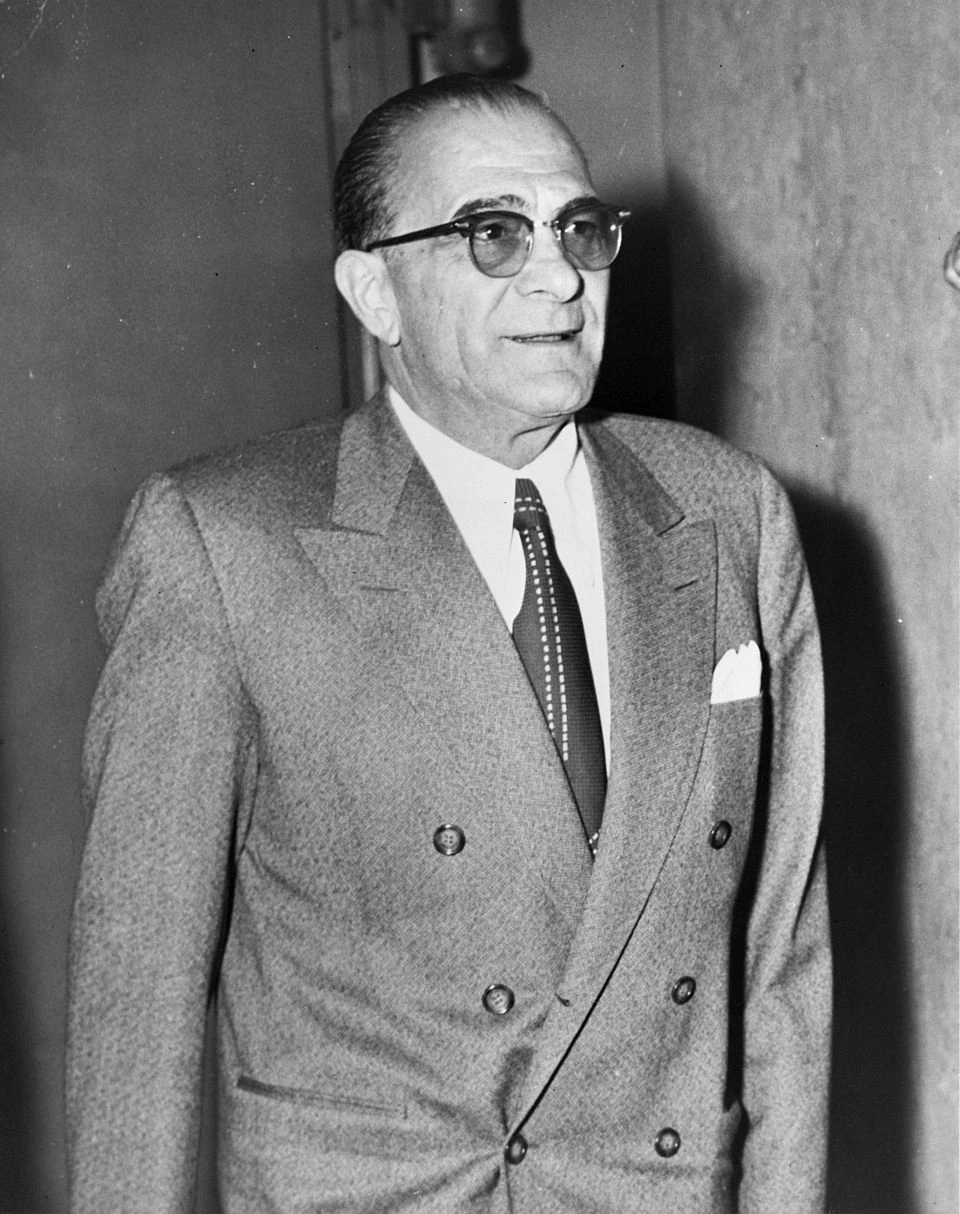
Vito Genovese (November 21, 1897 – February 14, 1969) was one of the most powerful organized crime figures in American history. Born in Italy, he immigrated to the United States and eventually rose through the ranks of what would become the Genovese crime family, one of the five dominant New York Mafia families. He served under and alongside Charles 'Lucky' Luciano in the Luciano crime family before consolidating his own power base. He died of a heart attack in a federal prison hospital in Springfield, Missouri, on Valentine's Day 1969, while serving a 15-year sentence stemming from a narcotics conspiracy conviction.
Estimating net worth for someone like Genovese is fundamentally different from profiling a celebrity or a business executive. There are no SEC filings, no public salary disclosures, no verified real estate portfolios in his name. What exists are court records, FBI surveillance files, grand jury testimony, informant accounts, and investigative journalism from the mid-20th century. The financial picture has to be reconstructed from fragments, and every reconstruction involves assumptions. That's true of most organized crime wealth estimates, whether you're looking at Genovese or at other figures in the same world.
The estimated net worth range and what the best evidence supports
Working from historical court records, contemporaneous news reporting, and documented FBI investigations, the most credible estimate places Genovese's personal wealth somewhere between $30 million and $75 million in late-1950s to early-1960s dollars. In inflation-adjusted 2026 terms, that band runs from roughly $310 million on the low end to about $770 million on the high end. The lower bound reflects only assets that can be reasonably inferred from documented sources: known real estate, reported business interests, and a conservative estimate of his share of criminal enterprises. The upper bound accounts for the likelihood that significant cash holdings and offshore or hidden assets were never surfaced by investigators.
It's worth being explicit about what we don't know. We have no verified balance sheet. We have no bank records made public. The IRS and FBI pursued Genovese aggressively, particularly after his 1959 narcotics conviction, but even extensive federal investigation rarely produces a complete picture of organized crime finances. The real figure could fall outside this range in either direction, though the evidence is more consistent with the upper end being plausible than with the lower end being the ceiling.
How wealth like this gets reconstructed from public records

Reconstructing the wealth of a historical organized crime figure follows a specific methodology, and understanding that methodology helps you evaluate any number you see online. The primary sources researchers draw on include federal court records and appeals decisions (the 1967 Second Circuit opinion in Genovese v. For example, the 1967 Second Circuit opinion in Genovese v. United States, 378 F.2d 748, is publicly accessible via Justia blank" rel="noopener noreferrer">(the 1967 Second Circuit opinion in Genovese v. United States, 378 F. 2d 748, is publicly accessible via Justia. United States, 378 F.2d 748, is publicly accessible via Justia and documents the post-conviction litigation after his narcotics sentence), FBI and DOJ investigation files released under FOIA, grand jury testimony that has since entered the public record, contemporaneous newspaper coverage from outlets like the New York Times, and books written by law enforcement figures and journalists who had access to primary sources. The 2d Cir. opinion in Genovese v. United States (378 F.2d 748) is hosted on Justia as part of the post-conviction litigation record blank" rel="noopener noreferrer">the 1967 Second Circuit opinion in Genovese v. United States (378 F.2d 748).
From those sources, researchers build an income model: what revenue streams existed, what his known cut of those streams would have been given his position in the hierarchy, and what documented assets or spending patterns suggest about accumulated wealth. The result is always a range, not a number, because multiple assumptions are required at each step. Sites that publish a single precise figure are collapsing that uncertainty into a false confidence.
Where the money likely came from
Genovese's income streams broke into several documented or strongly inferred categories. Organized crime bosses of his era typically earned through a combination of tribute payments from subordinates, direct participation in specific rackets, and legitimate business fronts used to launder and hold proceeds. For Genovese specifically, the most credible sources point to the following.
- Numbers and gambling operations: The illegal lottery and numbers rackets in New York generated enormous cash flow throughout the 1940s and 1950s. As a senior figure and eventually the acting or effective boss of his family, Genovese would have received a percentage of gross revenue from operations under his family's umbrella.
- Labor racketeering and union influence: The Genovese family, like other New York families, had documented ties to certain labor unions and construction-related industries. These relationships generated both direct payments and indirect economic benefits.
- Narcotics: Despite publicly claiming to oppose the drug trade (a position used strategically), Genovese was ultimately convicted of narcotics conspiracy. His 1959 conviction makes clear he was involved in heroin distribution at a significant organizational level. Drug revenue was among the highest-margin criminal income sources of the era.
- Loan sharking: Usurious lending was a standard income stream for organized crime figures, generating weekly cash returns on capital.
- Legitimate business fronts: Like most Mafia bosses, Genovese held interests in legitimate businesses used partly for income and partly for laundering. Specific documented holdings are limited in the public record, but contemporaneous reporting references restaurant and import interests.
- Real estate: Property ownership, often held through intermediaries, was a documented wealth-storage strategy for organized crime figures of this era.
The narcotics component deserves particular emphasis because it is the only income stream directly proven in a federal court. His conviction confirmed organizational involvement at a level that implies significant financial benefit, even if the precise dollar amounts were never established for the record.
How arrests, imprisonment, and legal jeopardy affected his wealth

Genovese's legal history had a material impact on both his wealth and his ability to accumulate more of it. His 1959 narcotics conspiracy conviction and subsequent 15-year sentence effectively ended his active management of criminal enterprises. While bosses often continued to exert influence from prison, the practical ability to direct operations, collect revenue, and protect assets diminishes significantly under incarceration. He died in prison in 1969, never having been released.
The legal proceedings also created direct asset exposure. Federal prosecutions of organized crime figures during this era, while not as systematically focused on asset forfeiture as modern RICO prosecutions, did involve IRS scrutiny and efforts to trace unexplained income. The government's case against Genovese included financial components, and any assets held in his name were subject to scrutiny. The practical result is that much of his wealth was likely already held in ways that obscured his ownership, meaning some portion may never have appeared in any public record at all and therefore cannot be counted in any defensible estimate.
It's also worth noting that earlier in his life, Genovese fled to Italy in 1937 to avoid a murder charge, returning only after the case collapsed. That period of exile likely disrupted his wealth accumulation and required resources to sustain himself abroad. These kinds of legal disruptions are rarely factored into net worth profiles of historical crime figures, but they matter.
Why different websites show such different numbers
If you search for Vito Genovese's net worth, you'll likely encounter figures ranging from a few million dollars to several hundred million, sometimes with no context at all. These discrepancies have a few common causes.
| Reason for Discrepancy | What It Means Practically |
|---|---|
| Time period not specified | A figure stated in 1960 dollars looks very different from the same figure in 2026 dollars. Sites often mix eras without adjusting. |
| Peak wealth vs. death-year wealth | Some estimates reflect wealth at his peak power in the mid-1950s; others attempt to capture what remained at his 1969 death, which was almost certainly less. |
| Inclusion vs. exclusion of undocumented assets | Conservative estimates only count traceable assets. Aggressive estimates include inferred but undocumented holdings, which can multiply the total several times over. |
| Copying and aggregation without sourcing | Many celebrity net worth sites copy figures from each other without independent research. An unsourced number gets treated as authoritative after enough repetition. |
| Confusion with family-level vs. personal wealth | Some estimates conflate the resources of the Genovese crime family as an enterprise with Genovese's personal share, which is a significant methodological error. |
The bottom line is that any single number you see without a methodology explanation should be treated as an approximation at best and fabrication at worst. The range approach, with explicit assumptions and uncertainty markers, is the only intellectually honest way to present this kind of estimate.
How to verify and interpret what you find: a practical checklist
If you want to go deeper on Genovese's finances beyond what any single article can provide, here are the most productive avenues and how to interpret what you find.
- Check federal court records directly: The Second Circuit's 1967 opinion in Genovese v. United States (378 F.2d 748) is freely accessible on Justia and provides legal context around his narcotics conviction and appeal. Court records are primary sources and carry more weight than any secondary website.
- Look at The Mob Museum's documented profile: The Mob Museum maintains historical profiles of organized crime figures based on verified historical records. It's one of the more reliable secondary sources for this subject.
- Search FBI FOIA releases: The FBI's online reading room (vault.fbi.gov) has released files on numerous organized crime figures. Genovese files, if available, would contain surveillance summaries and financial observations from the era.
- Use inflation calculators carefully: When you see a historical dollar figure, use a CPI-based calculator (the Bureau of Labor Statistics hosts one) to convert it to today's dollars. Be aware that conversion is approximate and that purchasing power for illicit assets doesn't translate cleanly.
- Ask whether a source cites its methodology: Any net worth estimate worth taking seriously should explain where the number comes from. If a site lists a figure with no sourcing, it's probably derivative or invented.
- Distinguish personal from enterprise wealth: When reading about organized crime figures, check whether a wealth claim is about the individual or the family/organization. These are different questions with very different answers.
- Be skeptical of round numbers: Figures like exactly '$10 million' or '$50 million' are usually approximations that have been rounded for readability. They are not precise measurements.
Common misconceptions worth clearing up
A few persistent misunderstandings tend to distort how people think about organized crime wealth, and they're worth addressing directly. First, being the 'boss' of a crime family does not mean controlling all of its revenue. The structure is more like a franchise or a tribute system: money flows up from earners to capos to bosses through a series of percentage cuts, and the boss's personal take, while substantial, is not the sum of the entire enterprise. Second, cash-heavy criminal wealth does not compound and grow the way invested legal wealth does. Hidden cash loses value to inflation; it can't be safely invested in markets without triggering scrutiny; and it's vulnerable to theft, seizure, and the death of the person who knows where it's kept. Third, dying in prison is a significant wealth event: without a legal estate that can be probated and distributed, much of what Genovese had accumulated likely dissipated, was distributed informally to associates before his death, or remained permanently hidden.
For context, Genovese is one of several historical figures named Vito whose net worth gets researched on sites like this one. For context, Genovese is one of several historical figures named Vito whose net worth gets researched on sites like this one, and you may also see similar searches for vito verni net worth when people compare different “Vito” labels online. If you came here searching for Vito Guzzo net worth, note that this article focuses specifically on Vito Genovese, not another person named Vito. If you were searching for Vito Picone net worth, keep in mind that similar naming confusion can lead to wildly different numbers without solid sourcing. The people searching for Vito Genovese are almost always looking for the Mafia don, not anyone else by that name. But it's worth being explicit: this article is specifically about Vito Genovese the organized crime boss, born 1897, died 1969, convicted of narcotics conspiracy in 1959. If you came here specifically for Vito Mielnicki net worth, you may be looking at a different person than the Vito Genovese discussed in this article. That's a different research question from, say, looking up younger figures in entertainment or business who share the first name.
FAQ
Why do some websites claim Vito Genovese net worth is far lower or far higher than the range discussed in this article?
Most single-number claims omit the assumptions used to convert testimony and asset clues into dollars. The biggest driver is whether they count only assets that can be reasonably attributed to him, or they speculate on hidden cash and off-the-books ownership without documenting a credible path from evidence to dollars.
What is the difference between “personal net worth” and “family wealth” in estimates of Vito Genovese net worth?
Personal net worth attempts to measure what Genovese could plausibly keep for himself after tribute cuts and operating expenses. Family wealth estimates often blur the issue by treating the enterprise as if the boss owned it outright, when in practice revenue flowed through hierarchy shares rather than a single owner’s balance sheet.
Does incarceration after the 1959 narcotics conviction usually reduce net worth estimates for Genovese?
Yes, because prison substantially limits the ability to direct collections, protect hidden assets, and adjust revenue channels. Many estimates also consider that legal pressure increases the likelihood of assets already being dispersed or placed under intermediaries, which can either lower what can be attributed to him or raise what could have existed but was never surfaced.
Can researchers use the sale, seizure, or tracing of specific assets to narrow Vito Genovese net worth?
Sometimes, but only partially. Many historical prosecutions focused on convictions and income inconsistencies rather than comprehensive public disclosure of a complete list of assets. Where investigators documented ownership or use, net worth can be anchored, but many holdings likely sat behind nominees, co-owners, or unrecorded arrangements.
How do historians handle spending patterns when estimating Vito Genovese net worth?
They often treat sustained high spending as corroboration but not proof of total wealth, because spending can be funded by short-term cash flows, access to intermediaries, or periodic collections. A conservative approach counts spending as a lower-bound signal, then separately estimates accumulated wealth from attributable asset clues.
Why are inflation conversions tricky when comparing Vito Genovese net worth across years?
Because the underlying evidence is mostly tied to late-1950s or early-1960s context, while some claims present numbers as if they come from a single “peak year.” Converting using a broad inflation measure can overstate or understate the result if the estimate year is unclear.
What common mistake should I avoid when using Vito Genovese net worth numbers to judge credibility?
Avoid treating a precise-looking figure as more reliable. When a source cannot explain what evidence produced the estimate (assets, income streams, hierarchy cut assumptions), the number often reflects guesswork disguised as math.
If there is no verified balance sheet, what is the most defensible way to interpret any Vito Genovese net worth claim?
Treat it as a range with explicit uncertainty. The most useful estimates separate (1) assets supported by documented attribution, (2) likely additional hidden holdings with a stated confidence level, and (3) adjustments for life events like exile and incarceration that disrupt wealth accumulation and preservation.
Did dying in prison affect what happened to Vito Genovese net worth after his death?
It likely did. Without a normal, provable legal estate, a portion of wealth can dissipate through informal transfers, vanish into hidden locations, or become hard to trace because there may be no court-recognized ownership trail. That tends to make post-death “reconstruction” undercount or leave gaps.
Is there a practical checklist I can use to evaluate a new Vito Genovese net worth estimate I find online?
Check whether the source states an evidence basis (specific records or case documents), explains the time period the number represents, distinguishes personal take from enterprise revenue, and acknowledges hidden-asset uncertainty. If it provides no methodology and no rationale for why its assumptions beat alternatives, treat it as entertainment rather than analysis.